
How I found peace in my kids' mess

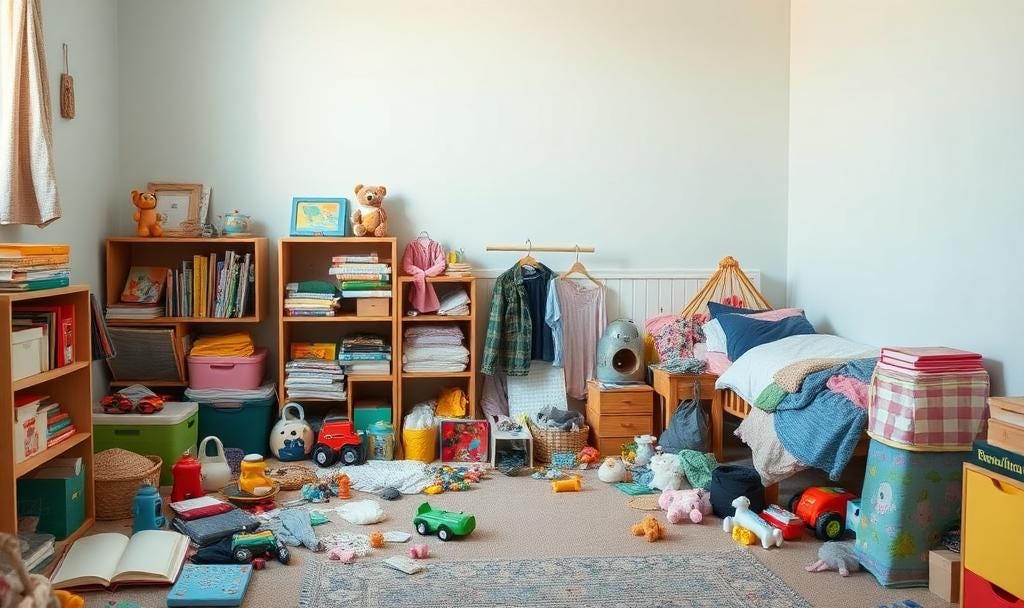
This realization has changed my perspective on my kids' mess and forever changed my relationship with them.
For quite some time, I thought my anger with my kids' mess came from their being irresponsible or disrespectful. I was taking it personally, believing they didn't care about my time or energy. And selfishly, I was even afraid that their mess would reflect poorly on my parenting or my reputation as a home organizer.
To some degree, those are true, but my realization went deeper.
Growing up, clutter was everywhere. Our home had rooms that looked like a storage unit. One room, in particular, had stacks of random things towering close to the ceiling, blocking the light from the window. I remember running through the only open path to the bathroom in that room, afraid of what might be lurking behind the piles.
That wasn’t my only fear. My parents had frequent shouting matches. Cleaning up our home helped keep me distracted and out of their way. It also helped me avoid their anger and gave me a sense of control when everything around me felt chaotic. I thought if I was good at being helpful, maybe they wouldn’t fight so much.
It didn’t take long for my parents to notice my efforts; I felt appreciated and seen. I believed I was worthy of their love because I earned it by helping around the house.
But when I became a mother and faced my kids' mess, an unexpected feeling surfaced. The mess didn't just annoy me—it triggered panic. I felt a sense of danger similar to that room from my childhood. Even when the mess was nowhere near that cluttered room, I wanted that feeling to disappear.
For a long time, I cleaned up my kids' mess myself. It felt satisfying and eased my anxiety from seeing the clutter. I felt...safe.
But I was worn out from cleaning up on my own. I was impatient because I also wanted my children to learn how to manage their messes and feel independent. Yet every time I tried to step back and let them handle it, I felt anxiety rising inside me.
It was as if I was at war with myself — one part desperate for peace through control, the other knowing my children needed the space to practice. I was torn between doing what would calm me in the short term and what would benefit my children in the long term.
Every time I saw my children's mess, I couldn't focus on anything else, and the longer the mess stayed, the more anxious I became.
I nagged, I yelled, I bribed them, but doing those things only made me angrier from the guilt of feeling like a bad parent.
It wasn't until I made the connection—my body had learned to see the mess as a threat—a threat of not receiving attention and affection from my parents. And unless I addressed that threat, unless I cleaned up, unless I showed a perfectly organized room, I may not be worthy of love.
Finally, I made the connection—my body had learned to see the mess as a threat—a threat of not receiving attention and affection from my parents. And unless I addressed that threat, I may not be worthy of love.
This realization was like peeling back another layer of healing—uncovering a part of my past that was still influencing me.
But with that understanding came a shift.
I started telling myself that the mess wasn’t dangerous and my worth wasn’t tied to how spotless my home was. I can believe in unconditional love from my family, that I won’t lose it even if I don’t keep everything in order.
An even more important realization is that I never want to pass this narrative to my children. I will love them, regardless of the mess they make. And they are not responsible for helping me regulate my emotions.
What they need is a mom who is present, to teach them life skills and not grow into people-pleasers because they don't have to prove they are worthy of my love.
This shift has changed my energy around my kids. My anxiety doesn't feel as overwhelming when the mess stays a little longer. And I can be patient and relaxed around my children, teaching them to clean up — not because I need the mess gone for my own peace, but because it's a life skill they'll need as they grow.
My career path and motivation to create the Dooley Method came out of coping with my childhood trauma. I've learned that the act of decluttering and organizing can come from a place of nurturing a sense of love and respect for myself, rather than to calm a panic. And I no longer feel the need to use cleaning up or organizing as a survival skill.
I share these stories because I know I am not alone, and if this feels familiar, I hope my experiences can help you find relief as well.
Thank you for sharing your story so openly, it resondated deeply - it’s a gift for all of us walking our own journeys.🥹